
To create a new competition, you must have a predefined competition type that will be selected from the system for the specific competition. Accordingly, the initial step of creating a New Competition is defining the Competition Type.
Competition types are used to group the competitions that have the same set of settings and belong to the same rank. The settings and details that are defined on the competition type are: organization, team type (club, national, or regional team), discipline (football, futsal, beach soccer), gender (mixed, male, female), age category (seniors, veterans, cases, junior, beginners, etc), match type (official, friendly) and rank of the competition.
Create a New Competition Type
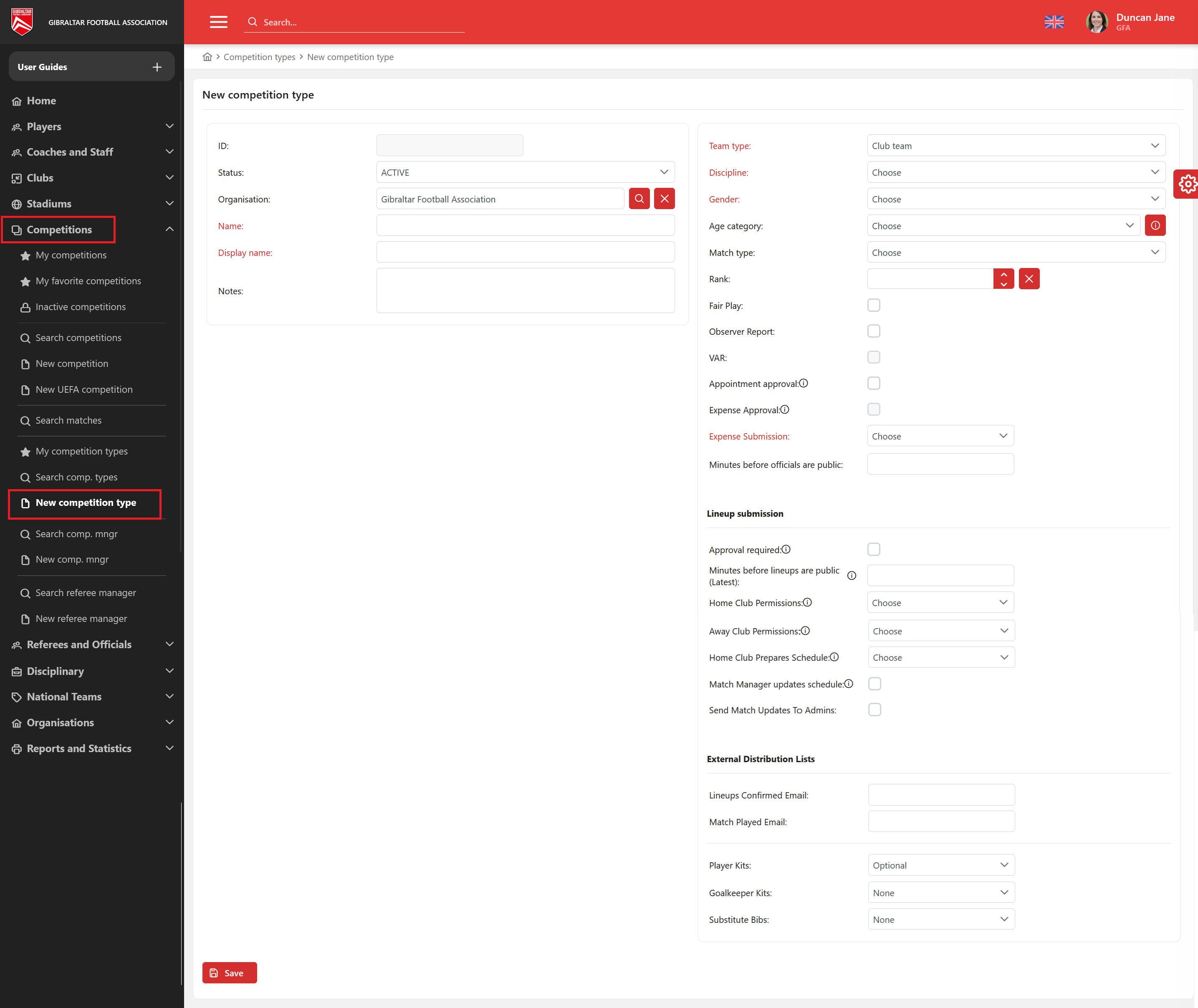
To create a new Competition Type, select the menu item New Competition Type under the Competitions menu on the left nav-bar and complete the fields described below. Mandatory fields are marked in red.
General Parameters
-
Status
-
Organization
-
Name (mandatory)
-
Display Name (mandatory)
-
Notes - internal notes about the competition type, e.g., when it should be used
-
Team type (mandatory) - club, national, regional team
-
Discipline (mandatory) - football, futsal, beach soccer
-
Gender (mandatory) - mixed, male, female
-
Age category (seniors, U21, U19, etc. → depending on your configuration: Age Category Details)
-
Match type (friendly, official, unofficial)
-
Rank
-
Fair Play - enable/disable Fair Play report for this competition type
-
Observer Report - enable/disable the Referee Observer Report for this competition type. See Referee Assessment for details.
-
VAR - only selectable when Observer Report is enabled. See Referee Assessment for details.
-
Appointment approval - if enabled, match officials must respond to their appointments, which are confirmed only after the official accepts them. Otherwise, all appointments are directly confirmed. See Enter Appointments and Respond to Appointments.
-
Expense Approval - If enabled, extends the expense workflow so that expenses submitted by the Match Official (or the Responsible Match Role for Expenses) are not confirmed automatically; they must first be reviewed and confirmed by an Administrator or Manager. See Competition and Competition Type Configuration for details.
-
Expense Submission (mandatory) - None, Self-Submission or Responsible Match Role. See Expense Submission.
-
Responsible Match Role for Expenses - the match role responsible for submitting expenses on behalf of all match officials, e.g., Referee. Mandatory if Expense Submission is set to Responsible Match Role, optional for Self-Submission.
-
Club Access to Expenses - defines whether the home club, the away club or both clubs have read-only access to the expense report. See Club Visibility.
-
Minutes before officials are public - restrict visibility of appointments until a certain point before the kick-off on scheduled matches.
Roster Parameters
Roster features described in this article will be deployed on all Demo instances by 28 October 2026 and migrated to Production on 12 January 2027.
The roster parameters are displayed in a separate panel on the left side of the screen, below the general parameters. They define how the Competition Roster is used in all competitions of this type:
-
Use Shirt Numbers in Roster (mandatory) - defines whether shirt numbers are assigned at the competition level:
-
Final - shirt numbers are defined in the roster, mandatory, and cannot be updated on the match lineup. This is common in professional competitions.
-
Default - shirt numbers are defined in the roster and mandatory, but serve as a default value that can be updated on each match lineup
-
None - shirt numbers are hidden on the roster and defined only on the match lineup
In all cases, the same shirt number cannot be assigned twice in the same roster. See Shirt Numbers.
-
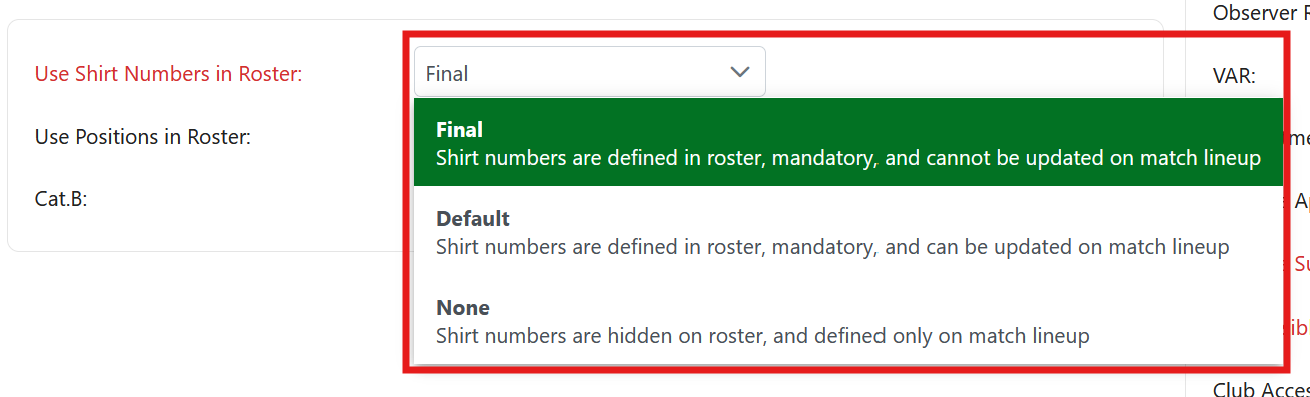
Use Shirt Numbers in Roster replaces the former Lock shirt number competition setting. Existing competition types have been configured accordingly: Final where Lock shirt number was enabled, Default where shirt numbers were shown in the roster, and None for all others.
-
Use Positions in Roster - if enabled, each player in the roster must have a defined position, e.g., Goalkeeper, Defender, Midfielder or Forward. A mandatory position dropdown is shown next to the shirt number, prefilled with the position from the player's profile where available, and the position is displayed on the Roster tab and on the print version of the roster. Disabled by default. See Positions.
-
B Roster - the label is localized per tenant, e.g., Cat.B. If enabled, the team rosters for all competitions of this type are split into A and B rosters, e.g., for youth players or an injury reserve list. The Max Players in B Roster setting is then displayed in the Roster panel of each competition. See B Roster.
Lineup Submission Parameters
-
Approval required - if enabled, lineups submitted by clubs must be reviewed and confirmed by the responsible match official or relevant administrators and managers. Otherwise, submitted lineups are confirmed immediately. See Lineups Workflow.
-
Minutes before lineups are public (Latest) - If entered, Lineups will become public at this point (minutes before kick-off) irrespective of any other conditions.
-
Home Club Permissions - None, Events Editor, Match Manager
-
If Events Editor is selected, the Club can update the live status and edit match events until the referee confirms the match. If Match Manager is selected, the Club will be able in addition to review and confirm the match, acting on behalf of the referee.
-
-
Away Club Permissions - None, Events Editor, Match Manager
-
If Events Editor is selected, the Club can update the live status and edit match events until the referee confirms the match. If Match Manager is selected, the Club will be able to, in addition to reviewing and confirming the match, act on behalf of the referee.
-
-
Home Club Prepares Schedule - No, Prepare, Prepare and Schedule. Lets Competition Admins delegate entry of the match schedule (date, time, facility) to the Home Club, for their home matches, while the match is in status ENTERED.
-
Prepare: the Home Club can only update the schedule data while the match remains in ENTERED.
-
Prepare and Schedule: the Home Club can, in addition, transition the match to status SCHEDULED.
Once the match is SCHEDULED, match stakeholders are notified and the Home Club can no longer make unilateral changes. This is a very useful feature for Competition Admins, allowing them to collect schedule data from clubs digitally, instead of receiving information offline and then retyping it into the system.
-
-
Match Manager Updates Schedule - If enabled, roles marked as Match Manager can edit the Facility, Pitch, and Start Datetime of a Match in statuses SCHEDULED and RETURNED.
-
Send Match Updates To Admins - Enable this setting to allow admins and managers to receive informational match update notifications for all matches within their competitions. These notifications include updates such as "Both Lineups Confirmed" and "Match Played”. Since these notifications are considered informational rather than operational or logistical, this setting is disabled by default.
External Distribution Lists
Lineups Confirmed Email and Match Played Email: an external e-mail address can be configured per Competition Type to receive these same two notifications - Both Lineups Confirmed and Match Played - for every match in competitions of this Competition Type.
-
Since these go to an external address rather than to COMET users, the relevant PDF is attached directly to the e-mail: the Start List PDF (Lineups Confirmed) or the Match Report PDF (Match Played).
-
If the address is a distribution list, a group email, or a mailbox with forwarding rules configured, you can use it to fan the notification out to any number of recipients by managing membership or forwarding rules in that email account, without needing a COMET user account for each recipient.
-
Before enabling this, consider that these PDFs may contain sensitive data (personal identifiers, card descriptions), depending on your tenant configuration - review what is included before distributing externally.
Formation, Kit, and Card Parameters
-
Tactical Formations - defines whether a tactical formation must be selected for the starting lineup, e.g., Optional or Mandatory.
-
Kit and Bib-related parameters:
-
Player Kits - choose between Optional and Mandatory. If Optional is selected, the Kit is displayed but not required for some matches. If Mandatory is selected, the Kit must be added to confirm the lineup.
-
Goalkeeper Kits and Substitute Bibs - same as Player Kits with additional third option: None. If None is selected, that kit is not displayed in the competition.
-
-
Yellow Card Counter Scope and Red Card Counter Scope (mandatory) - define the scope within which yellow and red cards are counted, e.g., Organization age category, Competition, or Age Category.
Hit the 💾 Save button to store a new competition type in the system.
To add competitions, you can select “New competition“ on the same screen, or you can do the same from the main menu.
Unofficial Match Type
In football, the vast majority of matches take place within official competitions, such as league matches, international friendlies, and tournament fixtures. However, there are also unofficial matches where football clubs play against national teams. These matches, while not recognized by central governing bodies like FIFA for official records, provide unique opportunities for players, teams, and fans.
If you want to create a competition that will have unofficial matches:
-
Create a competition type with the Match type set to Unofficial

-
Select the Registration parameter Invited teams in the Competition settings
-
Click on the Matches tab
-
Expand the Arrange Matches console
-
Add new Match

-
Search for the Football club that should play against the National team by clicking on the magnifier button or by typing the club’s name

-
Save the changes
