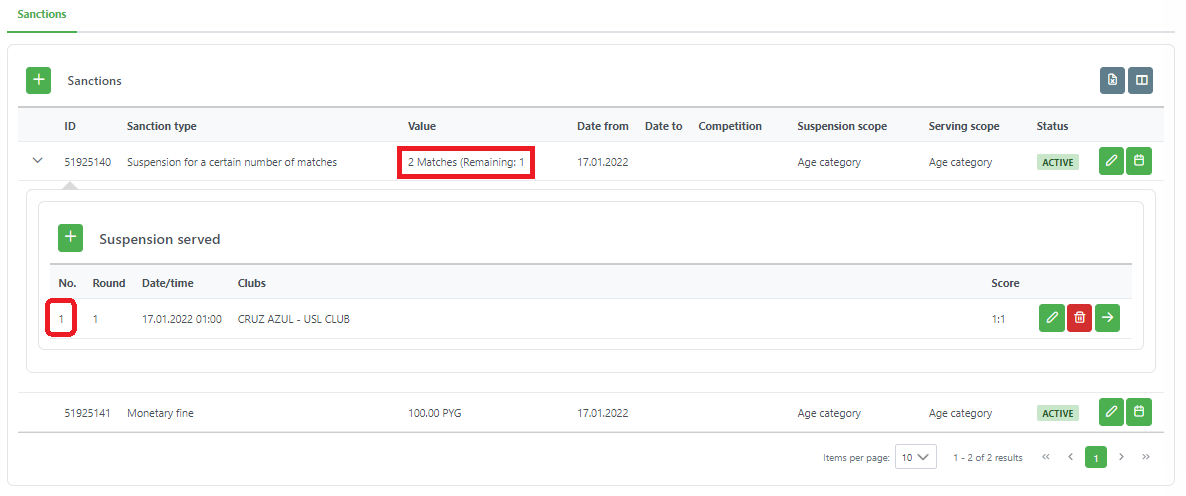
When a player or team official has an ACTIVE MATCH SUSPENSION in the system, he is supended in competitions (subject to Suspension Scope), and must serve (skip) matches in certain competitions, in order to close the suspension, and be eligible to play again.
The Serving Scope jointly with the Sanction Competition and Sanction Serving Team defines precisely in which competitions the person can serve its match suspension.
E.g. if a player received a red card for team NK Osijek in the HNS U21 Premier Division 24/25 then by default:
-
the Case Competition and Sanction Competition will be HNS U21 Premier Division 24/25 (although it can be updated manually by Disciplinary Admins).
-
the Serving Team will be NK Osijek (although it can be updated manually by Disciplinary Admins if player transfers and carries over suspension)
Now, if the Suspension Scope is Organization Age Category, the player will be able to serve matches of NK Osijek in any U21 Competition organized by HNS, where he would be otherwise eligible to play.
Serving Scopes
Below is the list of all Serving Scopes:
-
Competition Element - can serve only in the same competition (Sanction Competition), without considering other competition elements under the same Parent Competition.
-
Competition - can serve in the same competition (Sanction Competition), or in any competition elements under the same Parent as the Sanction Competition.
-
Competition Type - can serve in all competitions having the same Competition Type as the Sanction Competition.
-
Organization Age Category - can serve in all competitions having the the same Age Category and of same organizer (having the the same Competition Type Organization) as the Sanction Competition.
-
Age Category - can serve in all competitions having the same Age Category as the Sanction Competition.
-
Organization Team Type - can serve in:
-
all national team competitions having the same Competition Type Organization as the Sanction Competition - if the Sanction Competition is a national team competition
-
all club competitions having the same Competition Type Organization as the Sanction Competition - if the Sanction Competition a club competition
-
Please, note that this scope makes sense only in confederations such as OFC, CONMEBOL and CONCACAF, and it also differentiates between friendly and official competition types since suspension in an official match cannot be served in the friendly match and vice versa.
In all above cases, irrespective of Serving Scope, the Person can only serve their suspension in matches of the Serving Team (see below).
Serving Team
The Serving Team is a mandatory attribute of a Match Suspension sanction. Irrespective of Serving Scope, the Person can only serve their suspension in matches of that Serving Team.
For automatically created Sanctions, the Serving Team is set by default to the Team of the Case (i.e., where person received the card), so he will only be able to serve it for that team within that serving scope (unless the Serving Team is manually updated).
The Serving Team solves prevalent issues:
-
when a club has more than one team in a competition, then the Serving Team helps indicate where the sanction should be served (if the sanction is not initiated in the same competition/team)
-
when a player transfers to another club, carrying over the sanction from the previous club, then the serving team indicates in which team of the new club the sanction will be served. Such cases will end up in Unservable Sanctions Console and the Serving Team will need to be updated manually after the transfer.
The Serving Team (as well as other Sanction atributes, e.g. Competition) can be updated manually by Disciplinary Admins on the Sanction form
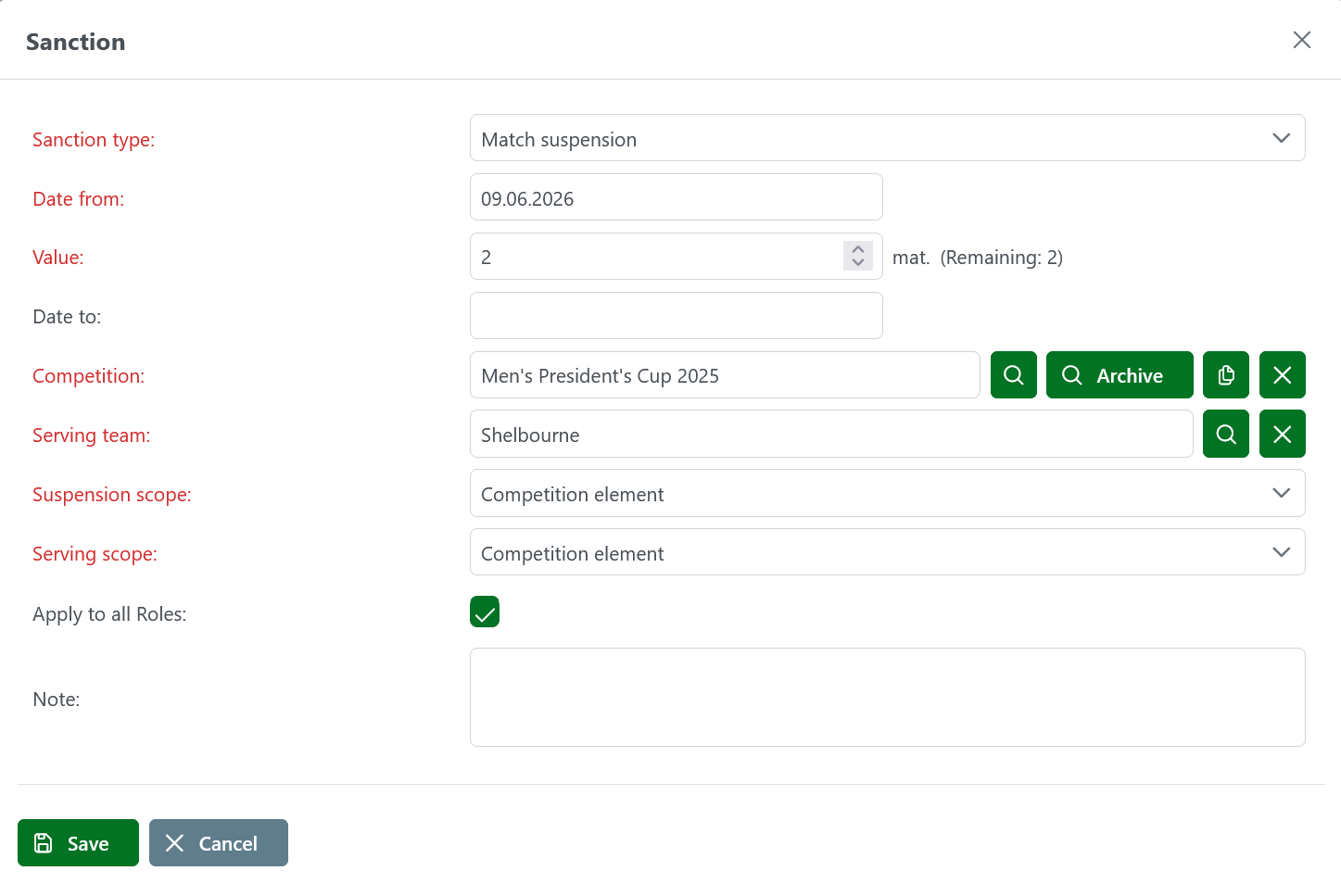
The Serving Team field will only appear if the sanction type is set to 'Match Suspension'.
Automatic Match Serving
In most cases, the match suspensions are served and closed fully automatically by COMET system, and there is no action required from disciplinary admins/managers.
When a Match is set to PLAYED, the COMET system serves all Active Match Suspension Sanctions where:
-
Sanction Competition is inside the Serving Scope of the Competition of the Match
-
Sanction Serving Team equals the Team that participated in the Match
-
The Person/Offender on the Case:
-
is eligible for that Match
-
does not have an appearance at the Match (Players and Team Officials are considered separately for Match Serving)
-
has not served another sanction or accumulated cards with that same Match
-
After a match serves a Match Suspension Sanction, the number of remaining matches to be served is reduced by 1. When the the number of remaining matches reaches 0, the sanction is CLOSED automatically.

Manual Match Serving
If for whatever reason (e.g. in case of retroactive entry of matches) a Match Suspension was not served automatically, it is also possible to serve them manually, i.e. enter matches on which the suspension was served. In order to do that:
-
open the case and expand the match suspension sanction (see image below),
-
click the
Add button to add the matches
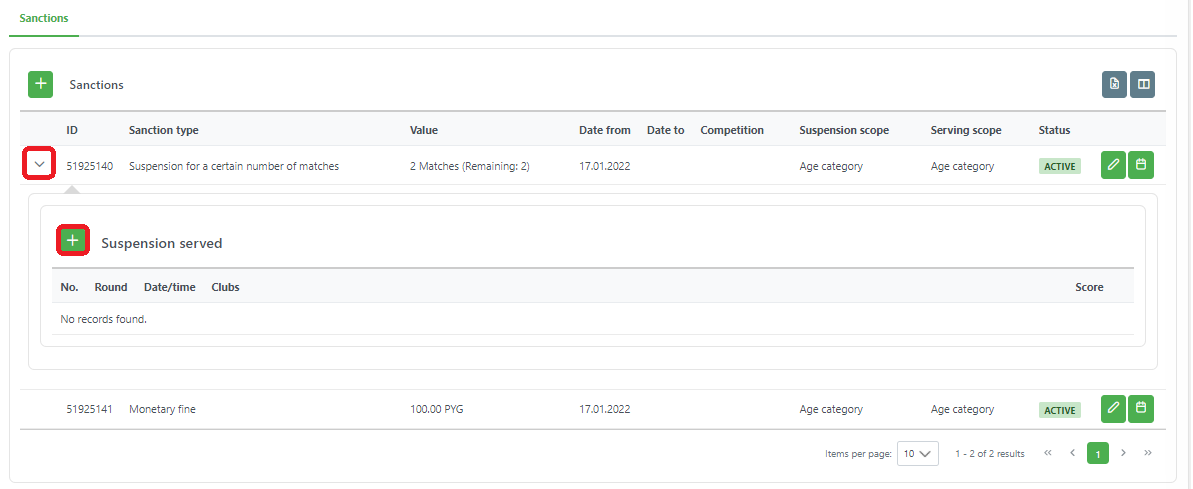
Only PLAYED matches of Serving Team in Serving Scope of Sanction Competition (where that person/offender did not appear in the lineup) can be used to manually serve a match suspension.
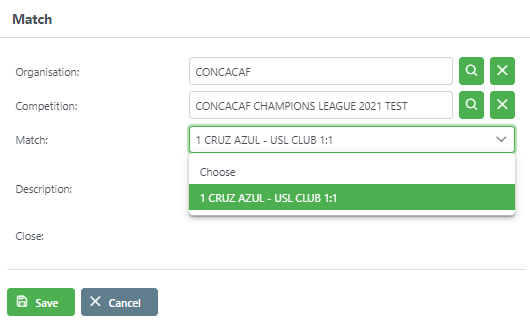
After adding matches, they appear on the list, and the number of remaining matches is reduced by 1. When the the number of remaining matches reaches 0, the sanction is CLOSED.